
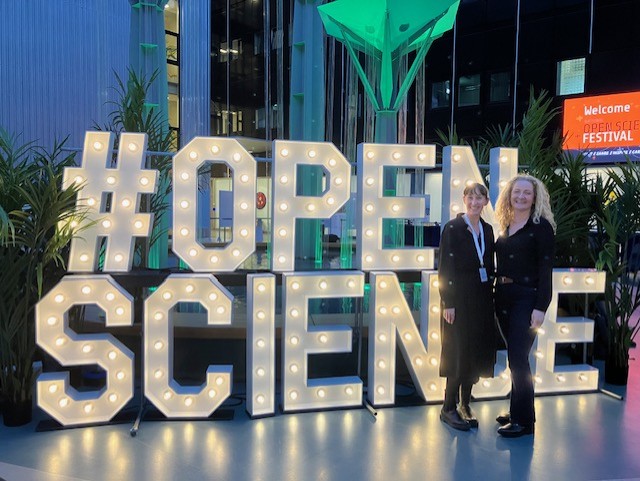
Anna Hughes, Development and engagement manager, Jisc, recently attended the Netherlands National Open Science Festival at the University of Groningen. Held annually for the past five years, it is an opportunity for the Dutch open science community – professional research support staff, researchers from across all disciplines, librarians and open access publishers – to mingle and meet, as well as welcoming the wider open science community to the conversation.
The UNESCO recommendation on open science states that open science aims to make scientific knowledge openly available, accessible and reusable for everyone. It seeks to foster scientific collaboration and information sharing for the benefit of both science and society.
Ana Persic, head of the open science programme at UNESCO, opened the Festival with a powerful keynote address. She emphasised the transformative potential of open science in tackling global environmental and socio-economic challenges, and reminded the audience why open science matters. Her speech set the tone for the festival’s programme and served as a timely reminder that, in an age of disinformation and big tech dominance, trustworthy science must remain accessible to those who need it most. She also acknowledged the growing resistance open science in some areas, driven by concerns including security and AI, and pointed to capacity gaps caused by geopolitical constraints and the high cost of open access publishing.
Casper Albers, co-chair of the Programme Committee and Dean of the Faculty of Behavioural and Social Sciences, received enthusiastic applause when he announced the University of Groningen’s intention to reduce its reliance on big tech by 2030.
Attendees then chose from a range of workshops based on their interests, before reconvening for plenary and panel sessions, poster presentations, and — naturally — coffee and speculoos biscuits (we were in the Netherlands, after all!).

Netherlands University Presses (NUPs). Why scholar-led open access publishing matters: opportunities, challenges, and the road ahead
Netherlands University Press (NUPs) a consortium of six (diamond) open-access publishers actively advances scholarly publishing in the Netherlands. Its members — Leiden University Press, Maastricht University Press, Open Press Tilburg University, Radboud University Press TU Delft Open Publishing and University of Groningen Press — vary in age, ambition, size and publication types but they share the same set of principles and values, with a commitment to democratising knowledge through diamond open access, where neither authors nor readers face financial barriers. As a collaborative network, the consortium works to amplify the visibility and impact of each member press. Together, they pursue joint initiatives such as developing a shared catalogue infrastructure, exploring a national open-access book platform, and collaborating on key areas including dissemination and promotion, metadata management, various peer review processes, and innovative publishing models.
Panel members spoke passionately about the power of collaboration — an overall theme of the Festival — in offering a genuine alternative to commercial, system driven publishing. They argued that knowledge is not a commodity to be traded. By focusing more on the content itself, they believe that under-represented disciplines and multilingual research can increase their visibility, with researchers making their work made freely accessible outside of academia. They also emphasised the need to safeguard knowledge and access to it, especially in an age of disinformation, with universities and scholar-led publishing playing a vital role.
The acknowledged issues including perceptions of sustainability, scaling up, prestige and an over-reliance on voluntary or in-kind contributions were addressed with a top down (universities and national funders) and bottom up (libraries and institutional press collaborations) approach advocated for, with all stakeholders collaborating to foster a community of care.
Open Science NL has funded NUPs for two years, and it will be fascinating to follow the consortiums progress of NUPs, especially in terms of collaborations with the national Diamond OA Expertise Centre. This centre forms part of the Strengthening Diamond Open Access in the Netherlands programme, launched by the Dutch Consortium of University Libraries (UKB) to reinforce and future-proof the country’s diamond Open Access publishing landscape.
Panellists ended the workshop with a positive message: research culture is evolving. By approaching diamond open access publishing as a national community, stakeholders can scale it up and offer a credible, sustainable alternative to commercial publishing.
Equity check: How fair is the scholarly communication model you support?
This workshop built upon themes from the previous session, prompting participants to consider how libraries can best allocate their budgets. In 2024, a multi-stakeholder Working Group — convened by cOAlition S, Jisc and PLOS — developed the How Equitable Is It? tool. Designed for research institutions, library consortia, funders and publishers — the stakeholders who either invest or receive funds for publishing services. The tool, recently updated, enables users to assess equity in scholarly communication models using seven criteria: Access to Read; Publishing immediate Open Access; Maximizing participation; Re-use rights; Pricing and fee transparency; Promoting and encouraging open research practices: data and code, and Promoting and encouraging open research practices: preprints and open peer review.
Given the ongoing Jisc negotiations with Elsevier, Springer Nature, Taylor & Francis, Wiley and Sage — alongside the sobering recognition of the financial challenges facing the UK higher education and research sector — the workshop offered a timely opportunity to feedback on the framework and showcase some unexpected acting talent through role play.
The workshop facilitator divided attendees into smaller groups and assigned each person a stakeholder role, all of whom were participating in a high-level research committee meeting at a Dutch higher education institution. To add complexity (and hilarity), each stakeholder held a pre-defined attitude toward open access, ranging from ambivalence to strong opposition—indicated by coloured stickers on their chairs.
I took on the challenging role of a programme officer from a national funding body who opposed open access. Unfortunately, my character became a significant obstacle to passing a more progressive research policy at the imaginary Dutch university … apologies!

Equitable Recognition and Reward through Open Science – disseminating Groningen’s Open Research Award across the Netherlands
Research culture and the push to change the status quo in how researchers are rewarded and recognised for open research continue to spark lively discussion. Both the plenary session ‘People of Open Science’ and the closing remarks underscored the importance of collaboration and community. They highlighted how strong community networks help researchers connect and how involving researchers and specifically grassroots communities more directly can drive a meaningful shift in attitudes toward open science.
The final workshop offered a practical example of this shift. The University of Groningen Library (UB), in partnership with the Open Science Community Groningen (OSCG), launched an annual Open Research Award (ORA) in 2020. Their goal was to highlight and celebrate individuals and teams who make their research more accessible, transparent, or reproducible. Instead of ranking submissions competitively, UB and OSCG adopted a modified lottery system to promote open research practices while reducing bias, increasing diversity, and easing academic competition. The simple application process encouraged reflection and prioritised inclusivity.
During an open discussion with last year’s ORA recipient, workshop participants clearly recognised how the ORA had strengthened pride and fostered a deeper sense of belonging among everyone involved in submissions. Several attendees from other Dutch institutions expressed interest in adopting the model at their own institutions — which was gratifying to see, especially since the framework and documentation are openly available. So keep an eye out: a nationwide Dutch ORA may soon be on the horizon!

Concluding thoughts
Firstly, it was fantastic to see so many researchers attending the event, leading debates and actively driving discussions. Scholarly communications professionals regularly discuss current recognition practice and their impact on open research, along with the urgent need to shift research culture for the better. Yet researchers — the very people most affected — often remain the hardest group to reach and therefore absent from these conversations. Their engagement is essential to advancing more equitable publishing practices.
Secondly, the thriving institutional publishing scene in the Netherlands also stood out, driven by strong collaboration among universities and national communities. Dutch researchers benefit from a robust national support network that also connects upwards with regional organisations like the European Diamond Capacity Hub.* Crucially, national funders such as the Dutch Research Council are playing a transformative role by enabling journals to flip to diamond open access, helping to build momentum toward a more inclusive and sustainable publishing ecosystem.
* As part of the festival I presented a poster ‘Ensuring Financial Sustainability for Diamond Open Access Journal Publishers: The DIAMAS Project’s Financial Sustainability Toolsuite’ [available on Zenodo]. The toolsuite is hosted on the EDCH.